Friday, February 12, 2021

A RIVER by A.K. Ramanujan

In Madurai,
city of temples and poets
who sang of cities and temples:
every summer
a river dries to a trickle
in the sand,
baring the sand-ribs,
straw and women's hair
clogging the watergates
at the rusty bars
under the bridges with patches
of repair all over them
the wet stones glistening like sleepy
crocodiles, the dry ones
shaven water - buffaloes lounging in the sun.
The poets sang of the floods.

He was there for a day
when they had the floods.
People everywhere talked'
of the inches rising,
of the precise number of cobbled steps
run over by the water, rising
on the bathing places.
and the way it carried off three village houses,
one pregnant woman
and a couple of cows
named Gopi and Brinda as usual.

The new poets still quoted
the old poets, but no one spoke
in verse
of the pregnant woman
drowned, with perhaps twins in her,
kicking at blank walls
even before birth.

He said:
the river has water enough
to be poetic
about only once a year
and then
it carries away
in the first half - hour
three village houses,
a couple of cows
named Gopi and Brinda
and one pregnant woman
expecting identical twins
with no moles on their bodies,
with different coloured diapers
to tell them apart.


I first read this poem in 2002 and hated it. This was around the time we used the term global warming to describe the environmental crisis. Terms like climate change came much later but all schools had started introducing some form of environmental studies by then. Ramanujan died in 1993, well before the apocalyptic possibility of humans destroying the planet had become a cause for concern. In fact, his generation, and even mine for that matter, has grown up reading the poems of Wordsworth and Shelley who describe the beauty of nature. When you look at The River in that context, it's impressively ahead of its time. 

In fact I think I think I hated the poem so much in school because around the same time, I was obsessively reading the Anne of Green Gables series (for those of you who haven't read it, please do - it's about 80% richly descriptive of the landscape and 20% about Canadian rural life that I didn't understand at all). So I was dragged straight from the laughing brook of Rainbow Valley with its pretty moss covered logs that make convenient seating spaces to this River Vaikai, repulsive, realistic and deadly. I still recoil in disgust when I read it. 

Obviously, that was Ramanujan's intention. He wanted us to shake off our idyllic notions of nature and the complacence with which we treat human suffering. Consider this - most of you reading this poem in school live in large cities. The fact that you've come to my blog on the internet to find an explanation of the poem means you have access to some amount of infrastructure. It's very easy for us to romanticize life by a river in the wilderness. We think of it as a vein of life and nurturing, which it is. All the great civilizations were built on the banks of rivers. Yet, as people who have not experienced its havoc, we don't consider that the river is also destructive, either by going dry and leaving behind the parched cracked earth, or flooding and submerging all that crosses its path. Consider what it would be like if your urban jungle collided with the destructive force of nature - that is what happened each year to Madurai. 

Ramanujan sets his poem in Madurai, where art flourished at the peak of Tamil culture. The poets of Madurai sing only of the splendour of cities and temples. They ignore the revolting decay of the city that Ramanujan paints for us in great detail. The image is loathsome as he describes the flotsam in the river and the ridges in the sand - bed that look like ribs. He describes the filth floating in the water. He shows us how poorly the dam and bridges are maintained, covered in rust and patches of shoddy repair. The stones resemble sunning crocodiles and water buffaloes lolling about in the sun.

But the poets sing only of the floods when the river shows some sign of life, when the ugliness is hidden from view. But with this new dynamism, the river also brings destruction and death. 


Ramanujan then introduces a persona he refers to only as 'He'. Whoever this persona is, he appears to be an outsider who can see the river for what it truly is and is not taken in by the poets' idyllic picture of it. Ramanujan goes on to describe the countdown to destruction as the water rises steadily over the bathing ghats. The poets continue to produce the same old stories, turning a blind eye to the pain and havoc brought on by the flood each year. They are so awed by the turbulence and fury of the river that they almost lose their sense of compassion towards those suffering around them. And so Ramanujan takes it upon himself to hold up the true picture.


He, (Ramanujan) as well as He, (the persona) talk about the lives lost in the flood. Unlike the other poets who are blinkered, he wants to immortalize in verse the drowned pregnant woman and the animals whose lives were also lost. 

Notice how the lines about the pregnant woman and the cows who were washed away are repeated. When do you repeat something? When you don't want people to forget. When you want to make sure they have heard you. Notice also that to emphasize the irony, the pregnant woman is nameless but the cows' names are mentioned twice. Right at the end of the poem, after shocking us out of complacence, Ramanujan talks about loss, to draw us towards empathy. How does he do that? Think about how you feel when you read about the pregnant woman. How did you feel when you read the last four lines of the poem? He first mentions her in Stanza 3 as the pregnant woman with "perhaps twins in her". Then he brings her up again in Stanza 4 but this time with more details in the last 4 lines. What are those details? Did anyone actually know if this nameless woman was going to have identical twins with no moles on their bodies and different coloured diapers to tell them apart? She's been swept away by the flood and in fact, no one will really know. What those lines convey, without explicitly saying so, are her dreams, the anticipation that she and her family must have had, what they imagined it would be like when the children were finally born. 

Hopefully, those of you reading this have never experienced a natural calamity, and hopefully you will never have to. But think back at all the times you have read about it in the news. How reports post numbers of people who have died. Ramanujan's poem is a reminder that the casualties of nature are not just numbers, they are real people and real animals who had dreams, who had names and who experienced pain and suffering and who deserve to be remembered, who deserve to have poems written about them, just like the river that swept them away. 

Sunday, February 23, 2014

Found A New Poet

I absolutely love how he writes! Not only does he have a way of expressing simple thoughts in a very beautiful manner, he also manages to use his poems to create shapes and give them a visual form.

Well done Joel A Doetsch. You have a fan.

And since I can't remember how to spell your name and have to keep googling various combinations, here's the link:

http://hellopoetry.com/joel-a-doetsch/


Tuesday, October 8, 2013

And the days are not full enough


I don't really want to analyse this poem. It doesn't need any analysis and that is how good poetry should be. I don't want to take it apart with a pseudo intellectual deeper meaning because it conveys its meaning so effortlessly anyway. So here it is. I hope you like it. What it says is exactly how I feel right now. 

Just so you know, Ezra Pound's life was full enough for a long time. He helped many of his contemporaries who shot to fame because of his efforts and after the First World War, he lost faith in England and moved to Italy. During the Second World War he strongly voiced his support for the Axis powers which led to his arrest for treason. He suffered a mental breakdown and much torture until he was finally released. He lived the rest of his life in Italy where he is buried. 


Thursday, March 28, 2013

Cherry Blossoms

And then... I come to this place of my ancestors and I remember, like these blossoms we are all dying. To know life in every breath, every cup of tea, every life we take; the way of the warrior. Life in every breath. That is Bushido

Katsumoto from The Last Samurai


Monday, March 25, 2013

10 MUST SEE SIGHTS IN SAN FRANCISCO

So I don't usually like these must see lists because the only thing you really must see is what you're interested in. And the minute something goes onto a list on the internet it's no longer a secret place. Obviously the best places are the ones we stumble upon ourselves, just strolling around but if you want to know what you shouldn't miss out on, here's a start.

The best thing about San Francisco is of course the Pacific. I don't think I could ever like a city that isn't by the sea. While Frisco isn't your typical beach, you know you'll always have spectacular sunsets here every day. 

1. Alcatraz


There's a certain eeriness to this windswept island. You know that some terrible things have happened here and in the clear light of day with pretty flowers nodding in the sea breeze you can ignore it, but you can't really shake off the feeling that this was once a dark and horrific place. It's worth visiting, simply to understand what it must have been like, and the audio tour presents the story from the point of view of the prison guards. Although I was a little disappointed that no one really describes anything about the Native American movement to reclaim Alcatraz.

2. Grace Cathedral


The doors are a copy of Ghiberti's Gates of Paradise and inside are several stunningly beautiful stained glass windows. On the floor within is a labyrinth, again a copy from a medieval church in France. Walking in the labyrinth is meant to induce a meditative state but the place is usually buzzing with tourists and most tour operators don't really give anyone enough time to look around, let alone meditate. 

3. City Lights Bookstore


It's a bookstore. Must I really provide other reasons? The founder, Lawrence Ferlinghetti was instrumental in publishing Allen Ginsberg's Howl and Other Poems which sparked a nationwide debate on obscenity and freedom of speech.

4. Lombard Street


A street with eight sharp turns, Lombard Street is one of the crookedest streets in the world and probably a nightmare to drive down. I wonder what would happen if I took my bicycle up there.

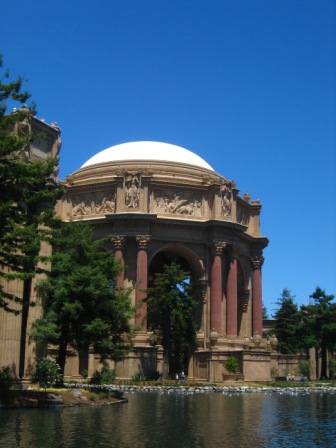
5. Palace of Fine Arts


The structure is meant to look like the ruins of a Greek temple, originally constructed for the 1915 Panama - Pacific Exposition. It was reconstructed 50 years later. To be honest, it made me feel a little cheated, like I was being sold a piece of history which was in fact just a modern construction. But if you put that aside and just see it for what it is, a beautiful building with a lagoon, it's a nice peaceful place.

6. Alamo Square


What I love the most about San Francisco - the Victorian houses. Each one is different from the others in some way, and they're all so colourful and sculptural. And of course, they remind me of Full House :)

7. Golden Gate Bridge


Apart from the obvious (it's ORANGE) the Golden Gate bridge is a remarkable feat of engineering, especially since it was one of the early suspension bridges to be build over such a long distance and has stood the test of time (and seismic activity). There's something reassuring about it... That no matter how wide or how deep the chasm, people can find a way to get across.

8. The Cable Car System


While I haven't ever had much fascination for cable cars, I think it's nice that they evoke the memory of someone who invested a lot of time, effort and money into having them built because he witnessed an unfortunate incident. I like that these cable cars are proof that people can be moved by what they see to make a positive change that helps society, while most others simply shrug their shoulders and walk on.

9. Powell and Market Street


Time to go shopping!!!!

10. Sausalito 


Don't be fooled. You're not in Europe and this isn't an idyllic fishing village. But it does a good job of appearing to be like one. It's a beautiful, quiet place that will remind you that you need to get a higher paying job if you want a house in a place like that. A much higher paying job. Probably 2 or 3 in fact. But I guess it's enough to just spend time in such places and know that they do exist.


Tuesday, November 13, 2012

William Wordsworth - An Analysis

To be honest, I'm not really a fan of Wordsworth. I have never managed to get through Tintern Abbey without falling asleep at least 3 times. But some of his poetry is actually some of my favourite poetry and since I had already written this essay I thought I should share it. This is the edited version. I obviously don't plan to share all of it unless I have a very good reason. I hope it helps you appreciate what he has written because whatever we may think now, what he did was really a leap ahead of his time.

William Wordsworth is universally regarded among the greatest poets of English literature. Charles William comments that Wordsworth, along with Shakespeare and Milton form the three great ranges of English poetry while other poets of equal height are mere peaks, thus comparing Wordsworth’s poetic skill to the breathtaking vastness of a mountain range.

At its greatest, Wordsworth’s poetry has a solemn sincerity beyond the compass of the human voice to utter. He does so by arousing a sense of unity of individual life with universal life.
“The shell of his verse ‘murmurs of the ocean from whence it came’; something more than us, more than Wordsworth, more than the poetry of Wordsworth, seems to open up and expand in the sound, as afterwards it withdraws and closes itself in the more expected, but still noble, verse to which it returns.” (Charles William)

In 1798, along with Coleridge, Wordsworth published The Lyrical Ballads which embodied his first major achievements in poetry. The famous Preface to The Lyrical Ballads lays down Wordsworth’s objectives and principles with reference to his poetry. In his own words,
“The principle object… proposed in these poems was to choose incidents and situations from common life, and to relate or describe them, throughout, as far as possible in a selection of language really used by men… and to make these incidents and situations interesting by tracing in them… primary laws of our nature.”

Didacticism is another of Wordsworth’s traits and he attempts to draw moral conclusions through his poetry. He was conscious of his moral purpose and made sure the reader did not miss the point. For example, in the Lucy Poem Three Years She Grew he narrates Lucy’s education by Nature and indirectly preaches the idea education of a child and the traits of a human being educated thus. In his own words, “Every great poet is a teacher: I wish either to be considered as a teacher or as nothing.”

In keeping with Rousseau’s notion of the ‘noble savage,’ Wordsworth shows a preference and respect for the humble and rustic life, believing that men are better and uncorrupted when closer to their ‘natural’ state. The poem about a shepherd and his son entitled Michael is a telling example of this:
                “His bodily frame had been from youth to age
                Of an unusual strength. Among the rocks
                He went, and still looked up to sun and cloud,
                And listened to the wind.”

Wordsworth describes himself as a “worshipper of nature.” His poetry is inextricably bound with nature as his own upbringing in the Lake District, his way of thinking, his lifestyle and outlook of life are influenced by it.
Natural objects played a significant part in Wordsworth’s emotional life, similar to the part real people play in our lives. They were a source of strength, delight and comfort as he narrates in The Daffodils:
                “And then my heart with pleasure fills
                And dances with the daffodils.”

Another example of Wordsworth’s deviation from the conventions of the time, aside from the points he stresses in the Preface is his introduction of autobiography into poetry as a central theme. For every poet his own experience is the raw material of the creative process but in Wordsworth’s case it is something more. His personal experience is his characteristic subject matter, so that much of his best verse constitutes a kind of diary. Thus Wordsworth in the Preface says, “Poetry is the spontaneous overflow of powerful feelings: it takes its origin from emotion recollected in tranquility.”

Wordsworth invites the reader to share the sensations and feelings experienced by the poet – persona, rather than just present them.

Romanticism celebrated the individual and this is evident in Wordsworth’s habit of introducing solitary figures. These figures are shrouded in an air of mystery, evoking sympathy and sometimes also fear. The Solitary Reaper, The Forsaken Indian Woman, Ruth, the shepherd at the end of Michael – all these, and more, sing their own solitary songs or preserve their solitary silences. The natural world too has its lone figures such as The Skylark or The Daisy. Looming above this is the recurrent solitude of Wordsworth himself. His poems often tell of individuals made lonely by their own actions or those of others, arousing in us a sense of our own capacity for solitude and endurance.
                “Behold her, singing in the field,
                Yon solitary Highland lass !
                Reaping and singing by herself;
                Stop here, or gently pass !”                                         (The Solitary Reaper)

Although frequently autobiographical, Wordsworth masterfully presents the experiences and suffering of others. Resolution and Independence, Margaret and Michael are 3 major examples of this. Margaret, for example, echoes Wordsworth’s own relationship with Annette Vallon who he abandoned in France. The poem tells of a woman deserted by her husband, her life prematurely extinguished and her surroundings left to decay. The tale is narrated by a lonely Wanderer. The pathos is real because it is not asserted but felt:
                “Then towards the cottage I returned; and traced
                Fondly, through with an interest more mild,
                That secret spirit of humanity
                Which ’mid the calm oblivious tendencies
                Of nature, ’mid her plants, and weeds, and flowers,
                And silent overgrowings, still survived.”

Tintern Abbey forms a kind of bridge which links the purely autobiographical poems with those that concern themselves with the “still, sad music of humanity.” Through “Nature,” it merges not only inanimate nature but human nature as well.

Sunday, April 8, 2012

The Pleiades

Just after sunset, look to the west. The brightest object in the sky is Venus and right below it, with a pair of binoculars you'll be able to see the Pleiades. :)

Monday, March 26, 2012

DREAM CATCHER

I made a dream catcher for a friend! :)


I don't have the skill or the cultural knowledge to make one like the Native Americans do but this is just a tribute to their incredibly fascinating philosophy and way of life. It's a beautiful thought that such a thing as a dream catcher has been invented and that it catches bad dreams in its web which disappear at daybreak and the good dreams filter through, slipping down the feathers to the person dreaming below. 

Dreams are the most intriguing part of our minds and I hope this gives its recipient many happy ones. 

Wednesday, March 14, 2012

Jane Austen's PRIDE AND PREJUDICE


Jane Austen’s most popular novel, ‘Pride and Prejudice’ deals with the theme of love and marriage in the rigid social structure in England in the early 19th century.  It tells the story of Elizabeth Bennet and Fitzwilliam Darcy, two of the most timeless and popular characters of literature.  Austen sets the theme of the novel in the very first sentence, “It is a truth universally acknowledged, that a single man in possession of a good fortune, must be in want of a wife.”
We are first introduced to witty and passive Mr. Bennet and his comical and garrulous wife.  Mrs. Bennet constantly complains of the condition of her poor nerves as she has five daughters to marry off.  Jane always sees the good in people, Elizabeth is sensible with a quick wit and their father loves them both.  Their younger sisters, Mary, Kitty and Lydia bring out much of Jane Austen’s humour.
Mr. Bingley and his friend, Mr. Darcy enter this sleepy neighbourhood and set the story in motion.  Austen brings out the troubles faced by women due to the inheritance laws at the time.  They were forced to marry wealthy men in order to secure their future.  On the death of Mr. Bennet, his property would pass to his cousin Mr. Collins as he has no male heirs.  Thus, there was no room for love or choice in making a match.  Women had to settle for what they could.  Thus, when Elizabeth rejects Mr. Collins’ proposal, we see that she is unlike other women of her time.  She refuses to compromise on her belief that nothing but the deepest love would make her marry a man.  However, her friend Charlotte is more practical and being the eldest among many siblings, she accepts Mr. Collins.
In the mean time, Elizabeth develops much hatred for Mr. Darcy as she thinks he is arrogant.  Mr. Wickham tells her more lies about Darcy that adds to her prejudice against him.  The class structure in England led land owners like Mr. Darcy to believe they were superior.  However we learn later in the novel that both the protagonists were under false first impressions of each other and the people around them.  Elizabeth was proud of her judgment of character but in her prejudice she had not noticed that Mr. Darcy was in fact a kind and generous man who was only looking after the best interests of his friend while Wickham was sly and unreliable.
When Lydia elopes with Wickham, Elizabeth and Darcy are finally brought together and they manage to overcome their pride and prejudices.  In portraying Lydia’s situation, Austen also subtly criticizes the society that condemns an entire family for the foolishness of one sister.  Austen’s quiet humour in dealing with characters like Mr. Collins, Lady Catherine and Miss Bingley serves to provoke change in society.
The beauty of ‘Pride and Prejudice’ is in the way Austen has shaped her characters, especially the two protagonists.  They seem to grow through the novel.  They overcome their faults and they are dynamic and multi-layered.  Both Darcy and Elizabeth refuse to compromise on their convictions and Elizabeth is unlike any woman of her time.  She is willing to risk everything for what she truly believes in, at a time when women were helpless and dependent.  She has strong opinions and the wit and sharpness to express them even in the face of spiteful remarks.  Mr. Darcy is proud but as Charlotte says, he has the right to be so.  Like Mr. Collins, Darcy’s first proposal is condescending and Lizzy rejects him like she did with Mr. Collins.  However Mr. Darcy manages to change and amend his actions and Elizabeth sees him for what he truly is.
Thus Jane Austen melds together her criticism of society and her skilful use of language and humour to create memorable characters.  With each reading, the novel seems to grow with oneself and that is what makes Pride and Prejudice a classic.

Sunday, February 26, 2012

Planetary Alignment

In the maddening crowd of Crawford Market, I suddenly chanced upon a sight I had been waiting for but had completely forgotten about... A delicate silver crescent hung in the sky. And above it, in a perfectly straight line were Venus and Jupiter shining silently in the blue evening twilight.
For that single moment, heaven was right above my head.

Friday, December 30, 2011

Better than Santa Claus

The best part about birthday parties when we were kids wasn't the cake or the games or the streamers. It was the presents. And the one thing I really regret about growing up is that we no longer have return presents at birthday parties.
On my trip to Mountain View to meet my brother, I met someone who has the coolest job in the world. My aunt has started a business of novelty party favours. She has the most creative, most fascinating collection of gift items and it's tempting enough to convince anyone that you're never too grown up to use stuff that's just so much fun. What I really liked was that all her gift ideas are useful.
I wish I could be a kid again if only just to give this stuff out as return presents at my birthday and see everyone using it at school the next day :)

Sunday, October 16, 2011

THE SKY IS A SHADECARD


Every day a new sunset appears outside my window. And it changes with each passing moment... while I sit in an air conditioned office with the blinds drawn, waiting for darkness. And no one around me realises we're missing the show.


Saturday, July 16, 2011

THE SLAVE'S DREAM by H.W. Longfellow

Beside the ungathered rice he lay,
His sickle in his hand;
His breast was bare, his matted hair
Was buried in the sand.
Again, in the mist and shadow of sleep,
He saw his Native Land.

Wide through the landscape of his dreams
The lordly Niger flowed;
Beneath the palm-trees on the plain
Once more a king he strode;
And heard the tinkling caravans
Descend the mountain-road.

He saw once more his dark-eyed queen
Among her children stand;
They clasped his neck, they kissed his cheeks,
They held him by the hand!--
A tear burst from the sleeper's lids
And fell into the sand.

And then at furious speed he rode
Along the Niger's bank;
His bridle-reins were golden chains,
And, with a martial clank,
At each leap he could feel his scabbard of steel
Smiting his stallion's flank.

Before him, like a blood-red flag,
The bright-flamingoes flew;
From morn till night he followed their flight,
O'er plains where the tamarind grew,
Till he saw the roofs of Caffre huts,
And the ocean rose to view.

At night he heard the lion roar,
And the hyena scream,
And the river-horse, as he crushed the reeds
Beside some hidden stream;
And it passed, like a glorious roll of drums,
Through the triumph of his dream.

The forests, with their myriad tongues,
Shouted of liberty;
And the Blast of the Desert cried aloud,
With a voice so wild and free,
That he started in his sleep and smiled,
At their tempestuous glee.

He did not feel the driver's whip,
Nor the burning heat of day;
For Death had illumined the Land of Sleep.
And his lifeless body lay
A worn out fetter, that the soul
Had broken and thrown away!


Probably the best loved of American poets the world over is Henry Wadsworth Longfellow. He was born on February 27th 1807 in Portland, Maine. At the age of 22 he was launched into his career as a college professor. In 1834, he was appointed to a professorship at Havard. Upon the death of his first wife, he came to Cambridge and to the new professorship. He was given honourary degrees at the great universities of Oxford and Cambridge, invited to Windsor by Queen Victoria and called by request upon the Prince of Wales. He died on March 24th 1882.

”Of all the suns of the New England morning,” says
Van Wyck Brooks, “he was the largest in his golden sweetness.”

A slave is one who is owned by another, and deprived of all rights and freedoms. The slave is dependant on the whim of the owner, who may generally force him to service and in principle, may usually dispose of his life.
The slaves in southern U.S. were forbidden by law to receive any education or acquire property and thus could rarely attain on their own, the means to buy their freedom.

Aside from domestic work, slaves were also instruments of production on farms, in mines and in factories owned by the master. The master provided them food and clothing. Punishments for misdemeanour were common.

The Slave’s Dream by H.W. Longfellow is a poem about one such slave who escaped despite the odds. The poem begins with the Slave lying on bare earth. Too exhausted to continue his work of gathering rice, the Slave was in the dreamy swoon of sleep, bare-chested, his tangled, unkempt hair buried in the sand, still clutching his sickle. In the mysterious shadow of sleep, he dreams of Africa, his home, his Native Land.

In his dream the slave sees the river Niger flow with all its majesty. He sees himself as the king he was. One can imagine a valiant warrior king striding through the plain, beneath priest like palm trees, listening to the distant tinkling of caravans down a mountain road.

In his dream, his mind wanders to his wife, the dark eyed queen of his land, standing amongst their children. He sees his children embrace him, kiss his cheeks, their little fingers clasping his hands. He does not know where they are, dead or alive, or whether he will ever see them again. His worry and longing for his family makes a tear drop from his eyes onto the sand.

He dreams of how he used to ride along the banks of the Niger with the wind on his face; the rich king of his land with golden bridle reins clanking as though he were going to war. Each time his horse would leap, he could feel his sword’s steel sheath strike the horse’s hide. Then, he was the one holding the chains, now he is bound by them.

Before him the flamingos like a blood red flag soared through the air. He followed them from dawn to dusk along the course of the Niger, over plains where the tamarind grew. He continued his hunt till he reached a village of caffre huts, where the Niger emptied into the ocean.

He dreams of how he heard the lion roar over its prey at night, the hyena scream and the sound of a river horse trampling reeds by an unseen stream. These familiar yet distant sounds passed through his mind like a great drumroll heralding a victorious king.

The forests were not bound by the will of another and the innumerable voices of the forest shouted of liberty. The Desert was its own master, untamed and free and when he hears it cry in its wild voice he starts in his sleep. In his sleep, he smiles at their exaltation, almost as though he is going to join them in their ecstatic delight.

The driver, a merciless superior in-charge, whips him for being asleep when he is supposed to work and the sun beats down ruthlessly upon him. But he is stolid towards the pain for Death had brightened up and beckoned him into the Land of eternal Sleep. His soul had left the confines of his body.

I love this poem for its simplicity. There is no judgment, no protest, no criticism. Whatever Africa may have been and whatever it may have became today, it will always have an unspoiled beauty and Longfellow has captured it in this poem.


Friday, July 8, 2011

Last Sunset of Summer 2011

"One day," you said to me, "I saw the sunset forty-four times!" 
And a little later you added:
"You know - one loves the sunset, when one is so sad..." 
"Were you so sad, then?" I asked, "on the day of the forty-four sunsets?" 
But the little prince made no reply. 


The Little Prince by Antoine de Saint-Exupéry


Thursday, June 2, 2011

Let Them Eat Cake

I was randomly looking at pictures of cakes yesterday afternoon and here's what I found
http://www.pinkcakebox.com/

Every single one of these cakes is like a work of art. How do people make something that looks so beautiful (and real) and tastes so good! (I obviously haven't tasted it but the flavours sound superb)
I honestly cannot believe those flowers are made of sugar. And how do people have the heart to cut these cakes when they have to eat them!

Mannequin Dress Form Cake with Roses Sew Fashion

Close-up of Roses Glamour

I've always thought that cooking well is a real talent but this is just something really really special. I'm sure it takes years of practice and experience to create something so unique and I couldn't help putting it up here.

I went through the whole gallery and these pictures are only a small glimpse of what is up there.

Pink Cake Box Cake

Pink Cake Box Cake

Pink Cake Box Cake

Pink Cake Box Cake

Friday, May 20, 2011

THE IGUANA by Isak Dinesen


In the reserve I have sometimes come upon the iguanas, the big lizards, as they were sunning themselves upon a flat stone in a river-bed. They are not pretty in shape, but nothing can be imagined more beautiful than their colouring. They shine like a heap of precious stones or like a pane cut out of an old church window. When, as you approach, they swish away, there is a flash of azure, green, and purple over the stones, the colour seems to be standing behind them in the air, like a comet's luminous tail.

Once I shot an iguana. I thought that I should be able to make some pretty things from his skin. A strange thing happened then, that I have never afterwards forgotten. As I went up to him, where he was lying dead upon his stone, and actually while I was walking the few steps, he faded and grew pale; all colour died out of him as in one long sigh, and by the time that I touched him he was grey and dull like a lump of concrete. It was the live impetuous blood pulsating within the animal which had radiated out all that glow and splendour. Now that the flame was put out, and the soul had flown, the iguana was as dead as a sandbag.

Often since I have, in some sort, shot an iguana, and I have remembered the one in the Reserve. Up at Meru I saw a young Native girl with a bracelet on, a leather strap two inches wide, and embroidered all over with very small turquoise-coloured beads which varied a little in colour and played in green, light blue, and ultramarine. It was an extraordinarily live thing; it seemed to draw breath on her arm, so that I wanted it for myself, and made Farah buy it from her. No sooner had it come upon my own arm than it gave up the ghost. It was nothing now, a small, cheap, purchased article of finery. It had been the play of colours, the duet between the turquoise and the 'nègre' -- that quick, sweet, brownish black, like peat and black pottery, of the Native's skin that had created the life of the bracelet.

In the Zoological Museum of Pietermaritzburg, I have seen, in a stuffed deep-water fish in a showcase, the same combination of colouring, which there had survived death; it made me wonder what life can well be like, on the bottom of the sea, to send up something so live and airy. I stood in Meru and looked at my pale hand and at the dead bracelet. It was as if an injustice had been done to a noble thing, as if truth had been suppressed. So sad did it seem that I remembered the saying of the hero in a book that I had read as a child: "I have conquered them all, but I am standing among graves."

In a foreign country and with foreign species of life one should take measures to find out whether things will be keeping their value when dead. To the settlers of East Africa I give the advice: 'For the sake of your own eyes and heart, shoot not the Iguana.'

In this story, the author describes one of her experiences in Africa, where she lived for several years. It is an extract from her book, Out of Africa which was published in 1937.  The book was written after she returned to Denmark.

The story begins with the author’s description of the iguana, an animal she is extremely fascinated by.  Her admiration for this creature is brought out by the way she describes it, comparing it to a heap of precious stones, and a pane cut out of an old church window.  They glitter in the sun like a mass of colour and as they hurriedly swish away on the approach of an intruder, their radiant colours seem to linger on like the afterglow of a comet. 

The author then narrates an incident that she has never forgotten since. She is tempted to shoot an iguana, thinking that she will be able to make some pretty things from its skin. However, as the iguana dies, its brilliant colours recede as the life ebbs out of its body. To her utter disappointment, the author finds that the dead iguana is drab and grey as a lump of concrete.

She goes on describe another incident where in attempting to remove an object from its rightful place, she feels she destroyed it.  However this time it is an inanimate bracelet that the author spots on the arm of a young Native girl.  The bead bracelet looks alive as its colours mingle in a complex play of blues and greens. It draws the author’s attention and she wants it for herself.  As soon as she wears it, she realises that its beauty lay in the exciting interaction of bright turquoise on the girl’s ebony skin.  As she sees it on her own arm she feels that the bracelet has lost its value and turned into a lifeless, cheap trinket.

The stuffed deep-water fish she sees at a zoo has not lost its colour after death.  It leads the author to marvel and wonder what life must be like at the bottom of the sea and that if a single, dead fish looks so beautiful, a whole shoal of living fish would be even more breath-taking and vibrant.

The author concludes with the thought that man should not interfere with nature because there is so much we do not understand about it.  In our greed and desire to acquire things we may destroy what is most pure and beautiful.

The author draws the reader’s attention by creating mental imagery with her descriptions.  She does so by using metaphors and similes that help us picture what she is describing.  Through the description, she also conveys the theme and message of her story.  As she describes the iguana’s brilliant beauty and the way its colours wane as it dies, the author subtly convinces the reader of the tragic waste of the animal’s life.

Tuesday, May 17, 2011

TO KILL A MOCKINGBIRD by Harper Lee


‘To Kill a Mockingbird’ is set in the 1930s in the sleepy town of Maycomb, Alabama.  It is set in a time when racial discrimination was extremely prevalent in the United States.  The story is about courage and innocence as a lawyer named Atticus Finch fights in court to save a black man who is falsely accused of raping a white girl.

            The story is told by Atticus’ daughter Scout as she looks back on her childhood.  Thus it is told through the eyes of a child.  Scout (Jean Louis) lives with her elder brother Jem and their father Atticus who has had to raise them himself with the help of their African-American housekeeper, Calphurnia.  She tells us the story that covers three years of her childhood.  We see the children grow from innocence to understanding as the novel progresses.

            The main plot highlights Atticus’ fight against racism as he defends Tom Robinson who is unjustly accused of raping Mayella Ewell.  A rigid social structure exists in Maycomb and African-Americans are at the very bottom of it.  They are segregated from the white people and we see this when Aunt Alexandra does not allow Scout to visit Calphurnia’s home.  The town’s racist attitude comes from blind prejudice.  The children had a superstitious fear of Boo Radley which did not come from any logical cause.  In fact he watched over them and when “Boo’s children needed him,” he came to save them.  Similarly, the town and the jury hold Tom guilty without any logical reason even though he helped Mayella out of kindness.

            As Atticus fights for justice, he also tries to teach his children the true meaning of courage.  Their childish concept of courage is touching the wall of the Radley Place because “in all his life, Jem had never declined a dare.”  Then they see their father kill a mad dog with a single shot.  However Atticus tells his children that real courage is more than a man with a gun.  He gives them the example of Mrs. Dubose who fought her morphine addiction.  Atticus says real courage is “when you know you’re licked before you begin but you begin anyway and you see it through no matter what.”  Thus when Atticus is facing a mob outside the jail house, Jem holds his ground and refuses to go home.  The children learn not to fight back when they are taunted about their father’s decision to defend Tom.

            By promising Atticus that they will not respond to taunts, the children also learn to understand people.  Their father tells them, You never really understand a person until you consider things from his point of view . . . until you climb into his skin and walk around in it.”  He teaches them to accept good and evil and to understand that they both may co-exist, even in the same person.

            As the children grow from innocence to understanding, Tom’s innocence is destroyed as he is killed.  Miss Maudie explains that it is a sin to kill a mockingbird as mockingbirds do no harm and only make sweet music.  Similarly, the jury and all of Maycomb committed the sin of sentencing Tom to death when all he did was help a girl whom he pitied.  Boo then saves the children from the revengeful Bob Ewell.  After having witnessed Tom’s trial, Scout is mature enough to understand that exposing a shy man like Boo to the public would be “sort of like shootin’ a mockingbird.”  She finally sees Boo as a man, not a monster and learns to look at the world through his eyes.  At the end of the novel she realizes the truth of what Atticus tells her, that most people are really nice when you finally see them.

Saturday, May 7, 2011

THE ONE RING - J.R.R. Tolkien


Three Rings for the Elven Kings under the sky,
Seven for the Dwarf lords in their halls of stone,
Nine for the Mortal men doomed to die,
One for the Dark Lord on his dark throne
In the land of Mordor where there shadows lie.
One ring to rule them all, One Ring to find them,
One Ring to bring them all and in the darkness bind them
In the land of Mordor where the shadows lie.


Monday, February 14, 2011

Outside My Window

Sometimes I sit and think and sometimes I just sit.

Monday, January 24, 2011

Outside My Window...

Clouds come floating into my life, no longer to carry rain or usher storm,
but to add colour to my sunset sky.
Rabindranath Tagore