Sunday, February 23, 2014

Found A New Poet

I absolutely love how he writes! Not only does he have a way of expressing simple thoughts in a very beautiful manner, he also manages to use his poems to create shapes and give them a visual form.

Well done Joel A Doetsch. You have a fan.

And since I can't remember how to spell your name and have to keep googling various combinations, here's the link:

http://hellopoetry.com/joel-a-doetsch/


Tuesday, October 8, 2013

And the days are not full enough


I don't really want to analyse this poem. It doesn't need any analysis and that is how good poetry should be. I don't want to take it apart with a pseudo intellectual deeper meaning because it conveys its meaning so effortlessly anyway. So here it is. I hope you like it. What it says is exactly how I feel right now. 

Just so you know, Ezra Pound's life was full enough for a long time. He helped many of his contemporaries who shot to fame because of his efforts and after the First World War, he lost faith in England and moved to Italy. During the Second World War he strongly voiced his support for the Axis powers which led to his arrest for treason. He suffered a mental breakdown and much torture until he was finally released. He lived the rest of his life in Italy where he is buried. 


Thursday, March 28, 2013

Cherry Blossoms

And then... I come to this place of my ancestors and I remember, like these blossoms we are all dying. To know life in every breath, every cup of tea, every life we take; the way of the warrior. Life in every breath. That is Bushido

Katsumoto from The Last Samurai


Monday, March 25, 2013

10 MUST SEE SIGHTS IN SAN FRANCISCO

So I don't usually like these must see lists because the only thing you really must see is what you're interested in. And the minute something goes onto a list on the internet it's no longer a secret place. Obviously the best places are the ones we stumble upon ourselves, just strolling around but if you want to know what you shouldn't miss out on, here's a start.

The best thing about San Francisco is of course the Pacific. I don't think I could ever like a city that isn't by the sea. While Frisco isn't your typical beach, you know you'll always have spectacular sunsets here every day. 

1. Alcatraz


There's a certain eeriness to this windswept island. You know that some terrible things have happened here and in the clear light of day with pretty flowers nodding in the sea breeze you can ignore it, but you can't really shake off the feeling that this was once a dark and horrific place. It's worth visiting, simply to understand what it must have been like, and the audio tour presents the story from the point of view of the prison guards. Although I was a little disappointed that no one really describes anything about the Native American movement to reclaim Alcatraz.

2. Grace Cathedral


The doors are a copy of Ghiberti's Gates of Paradise and inside are several stunningly beautiful stained glass windows. On the floor within is a labyrinth, again a copy from a medieval church in France. Walking in the labyrinth is meant to induce a meditative state but the place is usually buzzing with tourists and most tour operators don't really give anyone enough time to look around, let alone meditate. 

3. City Lights Bookstore


It's a bookstore. Must I really provide other reasons? The founder, Lawrence Ferlinghetti was instrumental in publishing Allen Ginsberg's Howl and Other Poems which sparked a nationwide debate on obscenity and freedom of speech.

4. Lombard Street


A street with eight sharp turns, Lombard Street is one of the crookedest streets in the world and probably a nightmare to drive down. I wonder what would happen if I took my bicycle up there.

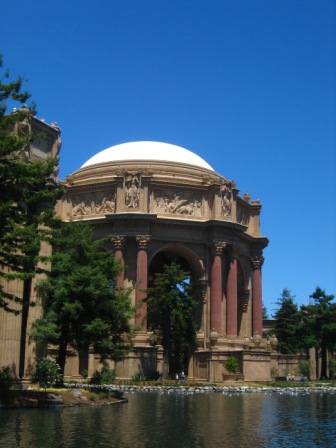
5. Palace of Fine Arts


The structure is meant to look like the ruins of a Greek temple, originally constructed for the 1915 Panama - Pacific Exposition. It was reconstructed 50 years later. To be honest, it made me feel a little cheated, like I was being sold a piece of history which was in fact just a modern construction. But if you put that aside and just see it for what it is, a beautiful building with a lagoon, it's a nice peaceful place.

6. Alamo Square


What I love the most about San Francisco - the Victorian houses. Each one is different from the others in some way, and they're all so colourful and sculptural. And of course, they remind me of Full House :)

7. Golden Gate Bridge


Apart from the obvious (it's ORANGE) the Golden Gate bridge is a remarkable feat of engineering, especially since it was one of the early suspension bridges to be build over such a long distance and has stood the test of time (and seismic activity). There's something reassuring about it... That no matter how wide or how deep the chasm, people can find a way to get across.

8. The Cable Car System


While I haven't ever had much fascination for cable cars, I think it's nice that they evoke the memory of someone who invested a lot of time, effort and money into having them built because he witnessed an unfortunate incident. I like that these cable cars are proof that people can be moved by what they see to make a positive change that helps society, while most others simply shrug their shoulders and walk on.

9. Powell and Market Street


Time to go shopping!!!!

10. Sausalito 


Don't be fooled. You're not in Europe and this isn't an idyllic fishing village. But it does a good job of appearing to be like one. It's a beautiful, quiet place that will remind you that you need to get a higher paying job if you want a house in a place like that. A much higher paying job. Probably 2 or 3 in fact. But I guess it's enough to just spend time in such places and know that they do exist.


Tuesday, November 13, 2012

William Wordsworth - An Analysis

To be honest, I'm not really a fan of Wordsworth. I have never managed to get through Tintern Abbey without falling asleep at least 3 times. But some of his poetry is actually some of my favourite poetry and since I had already written this essay I thought I should share it. This is the edited version. I obviously don't plan to share all of it unless I have a very good reason. I hope it helps you appreciate what he has written because whatever we may think now, what he did was really a leap ahead of his time.

William Wordsworth is universally regarded among the greatest poets of English literature. Charles William comments that Wordsworth, along with Shakespeare and Milton form the three great ranges of English poetry while other poets of equal height are mere peaks, thus comparing Wordsworth’s poetic skill to the breathtaking vastness of a mountain range.

At its greatest, Wordsworth’s poetry has a solemn sincerity beyond the compass of the human voice to utter. He does so by arousing a sense of unity of individual life with universal life.
“The shell of his verse ‘murmurs of the ocean from whence it came’; something more than us, more than Wordsworth, more than the poetry of Wordsworth, seems to open up and expand in the sound, as afterwards it withdraws and closes itself in the more expected, but still noble, verse to which it returns.” (Charles William)

In 1798, along with Coleridge, Wordsworth published The Lyrical Ballads which embodied his first major achievements in poetry. The famous Preface to The Lyrical Ballads lays down Wordsworth’s objectives and principles with reference to his poetry. In his own words,
“The principle object… proposed in these poems was to choose incidents and situations from common life, and to relate or describe them, throughout, as far as possible in a selection of language really used by men… and to make these incidents and situations interesting by tracing in them… primary laws of our nature.”

Didacticism is another of Wordsworth’s traits and he attempts to draw moral conclusions through his poetry. He was conscious of his moral purpose and made sure the reader did not miss the point. For example, in the Lucy Poem Three Years She Grew he narrates Lucy’s education by Nature and indirectly preaches the idea education of a child and the traits of a human being educated thus. In his own words, “Every great poet is a teacher: I wish either to be considered as a teacher or as nothing.”

In keeping with Rousseau’s notion of the ‘noble savage,’ Wordsworth shows a preference and respect for the humble and rustic life, believing that men are better and uncorrupted when closer to their ‘natural’ state. The poem about a shepherd and his son entitled Michael is a telling example of this:
                “His bodily frame had been from youth to age
                Of an unusual strength. Among the rocks
                He went, and still looked up to sun and cloud,
                And listened to the wind.”

Wordsworth describes himself as a “worshipper of nature.” His poetry is inextricably bound with nature as his own upbringing in the Lake District, his way of thinking, his lifestyle and outlook of life are influenced by it.
Natural objects played a significant part in Wordsworth’s emotional life, similar to the part real people play in our lives. They were a source of strength, delight and comfort as he narrates in The Daffodils:
                “And then my heart with pleasure fills
                And dances with the daffodils.”

Another example of Wordsworth’s deviation from the conventions of the time, aside from the points he stresses in the Preface is his introduction of autobiography into poetry as a central theme. For every poet his own experience is the raw material of the creative process but in Wordsworth’s case it is something more. His personal experience is his characteristic subject matter, so that much of his best verse constitutes a kind of diary. Thus Wordsworth in the Preface says, “Poetry is the spontaneous overflow of powerful feelings: it takes its origin from emotion recollected in tranquility.”

Wordsworth invites the reader to share the sensations and feelings experienced by the poet – persona, rather than just present them.

Romanticism celebrated the individual and this is evident in Wordsworth’s habit of introducing solitary figures. These figures are shrouded in an air of mystery, evoking sympathy and sometimes also fear. The Solitary Reaper, The Forsaken Indian Woman, Ruth, the shepherd at the end of Michael – all these, and more, sing their own solitary songs or preserve their solitary silences. The natural world too has its lone figures such as The Skylark or The Daisy. Looming above this is the recurrent solitude of Wordsworth himself. His poems often tell of individuals made lonely by their own actions or those of others, arousing in us a sense of our own capacity for solitude and endurance.
                “Behold her, singing in the field,
                Yon solitary Highland lass !
                Reaping and singing by herself;
                Stop here, or gently pass !”                                         (The Solitary Reaper)

Although frequently autobiographical, Wordsworth masterfully presents the experiences and suffering of others. Resolution and Independence, Margaret and Michael are 3 major examples of this. Margaret, for example, echoes Wordsworth’s own relationship with Annette Vallon who he abandoned in France. The poem tells of a woman deserted by her husband, her life prematurely extinguished and her surroundings left to decay. The tale is narrated by a lonely Wanderer. The pathos is real because it is not asserted but felt:
                “Then towards the cottage I returned; and traced
                Fondly, through with an interest more mild,
                That secret spirit of humanity
                Which ’mid the calm oblivious tendencies
                Of nature, ’mid her plants, and weeds, and flowers,
                And silent overgrowings, still survived.”

Tintern Abbey forms a kind of bridge which links the purely autobiographical poems with those that concern themselves with the “still, sad music of humanity.” Through “Nature,” it merges not only inanimate nature but human nature as well.

Sunday, April 8, 2012

The Pleiades

Just after sunset, look to the west. The brightest object in the sky is Venus and right below it, with a pair of binoculars you'll be able to see the Pleiades. :)

Monday, March 26, 2012

DREAM CATCHER

I made a dream catcher for a friend! :)


I don't have the skill or the cultural knowledge to make one like the Native Americans do but this is just a tribute to their incredibly fascinating philosophy and way of life. It's a beautiful thought that such a thing as a dream catcher has been invented and that it catches bad dreams in its web which disappear at daybreak and the good dreams filter through, slipping down the feathers to the person dreaming below. 

Dreams are the most intriguing part of our minds and I hope this gives its recipient many happy ones.